

TAISE Expands TCSA Industry Classification to 48 Categories
Strengthening Peer Comparisons with an Evaluation Framework Closer to Industry Realities
TAISE Expands TCSA Industry Classification to 48 Categories
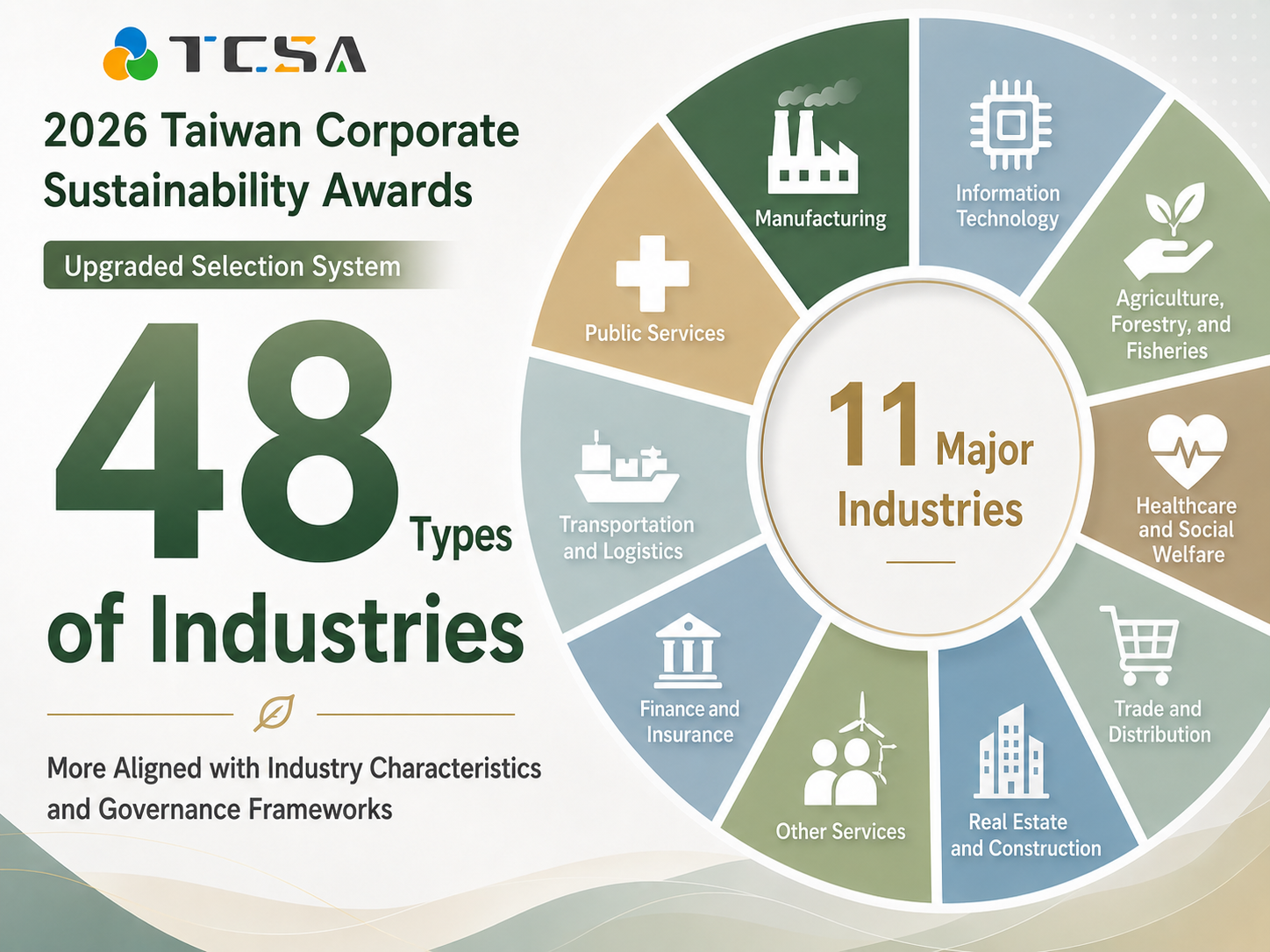
As sustainability governance evolves from advocacy to institutionalized practice, the sustainability issues and transformation pathways faced by companies are becoming increasingly industry-specific. To ensure that the award results better reflect actual business operations, the Taiwan Institute for Sustainable Energy (TAISE) has announced that, starting from this year, the Taiwan Corporate Sustainability Awards (TCSA) will adjust its industry classification framework for sustainability awards, enabling companies within the same industry to be evaluated on a fairer and more reasonable basis.
TAISE stated that some previous industry classifications were relatively broad, which could result in companies with different business models competing within the same category, despite facing significantly different sustainability issues and governance approaches. This adjustment is primarily based on the Standard Industrial Classification of the Directorate-General of Budget, Accounting and Statistics, Executive Yuan, and also references the Global Industry Classification Standard (GICS) and the Taiwan Stock Exchange industry classification system. The framework has been revised into 11 major sectors and 48 industry categories. The evaluation dimensions and key criteria for each industry category remain unchanged, and the evaluation standards for participating companies remain consistent.
Among the changes, “Electronic Information Manufacturing” has been further subdivided according to industry characteristics into categories such as Integrated Circuits, Semiconductor Packaging and Testing, Passive Components and Discrete Components, Printed Circuit Boards and Assemblies (PCB/PCBA), Optoelectronics, Computers and Peripheral Equipment, Electronics Manufacturing Services (EMS/ODM), Information Services, and Digital Cloud. The original “Financial and Insurance Industry” has also been further divided by business nature into Banking, Insurance, Securities, and Other Financial Services, allowing different financial institutions to be compared within a framework that better reflects their business characteristics.
In addition, the “Transportation Industry” has been divided by mode of transportation into Maritime Transportation, Air Transportation, Land Transportation, and Logistics. The original “Trading and Department Stores” category has also been separated into Department Store Retail, Convenience Stores and Supermarkets, and Trading. Categories such as the “Energy Industry” and “Real Estate and Construction Industry” have also been adjusted in terms of classification structure and industry segmentation to reflect different industry characteristics, supply chain roles, business models, and governance needs, thereby strengthening the basis for peer comparison and industry identification.
TAISE pointed out that through a more refined classification mechanism, governance achievements and industry characteristics that were previously less visible within large industry categories are expected to be presented more appropriately. This will also help companies of different scales demonstrate their sustainability governance achievements within a framework that is more closely aligned with their industry characteristics. The updated industry classification will apply simultaneously to the Corporate Sustainability Comprehensive Performance Awards and the Sustainability Report Awards, enabling the award results to more fully reflect the diverse landscape of sustainability governance across Taiwan’s industries.
TCSA Taiwan Corporate Sustainability Awards・Corporate Sustainability Comprehensive Performance Awards
| No. | Major Sector | Eligible Industry Category |
|---|---|---|
| 1 | Information Technology | Integrated Circuits |
| 2 | Semiconductor Packaging and Testing | |
| 3 | Passive Components and Discrete Components | |
| 4 | Printed Circuit Boards and Assemblies (PCB/PCBA) | |
| 5 | Optoelectronics | |
| 6 | Computers and Peripheral Equipment | |
| 7 | Electronics Manufacturing Services (EMS/ODM) | |
| 8 | Information Services | |
| 9 | Digital Cloud | |
| 10 | Financials | Financial Holding Companies |
| 11 | Banking | |
| 12 | Insurance | |
| 13 | Securities, Futures, Investment Trusts, and Investment Consulting | |
| 14 | Health Care | Pharmaceutical Manufacturing |
| 15 | Medical Devices | |
| 16 | Biotechnology | |
| 17 | Health and Wellness | |
| 18 | Industrials | Electrical Machinery |
| 19 | Machinery | |
| 20 | Electric Wires and Cables | |
| 21 | Electronic Distribution | |
| 22 | Trading | |
| 23 | Maritime Transportation | |
| 24 | Air Transportation | |
| 25 | Land Transportation | |
| 26 | Logistics | |
| 27 | Engineering Contracting | |
| 28 | Environmental Services | |
| 29 | Consumer Discretionary | Automobile Industry |
| 30 | Textiles, Fibers, and Household Goods | |
| 31 | Tourism and Hospitality | |
| 32 | Sports and Leisure | |
| 33 | Department Store Retail | |
| 34 | Consumer Staples | Food Industry |
| 35 | Convenience Stores and Supermarkets | |
| 36 | Communication Services | Communications and Network Industry |
| 37 | Energy | Oil, Electricity, Gas, and Fuel |
| 38 | Renewable Energy | |
| 39 | Materials | Steel and Iron |
| 40 | Chemical Industry | |
| 41 | Plastics Industry | |
| 42 | Rubber Industry | |
| 43 | Cement Industry | |
| 44 | Paper Industry | |
| 45 | Glass and Ceramics | |
| 46 | Real Estate | Real Estate Development |
| 47 | Real Estate Services | |
| 48 | Utilities | Utilities |